

As an indie SaaS founder or lean engineering team lead, you wear a dozen hats. Between shipping features, talking to customers, and managing server bills, security often feels like a checklist item you rush through to satisfy a vendor questionnaire. For years, the gold standard for web apps has been simple: run an external vulnerability scanner against your public domain, verify that your SSL cert is valid, make sure port 80 redirects to 443, and call it a day.
But here is the hard truth - external-only scans only see the tip of the iceberg. Modern cloud architectures, containerized microservices, and remote engineering teams mean your perimeter is no longer a solid brick wall. It is a porous membrane. If an attacker breaches a single low-privilege service or compromises a developer laptop, external-only scanning leaves your internal assets completely exposed.
In this guide, we will explore why internal network vulnerability scanning is critical for indie SaaS and small MSPs, what external tools miss, how customer diligence is changing, and a lightweight approach you can implement this week without hiring a dedicated security team.
What External-Only Scans Miss
When you run a traditional external vulnerability scan, the tool simulates an attacker sitting on the public internet. It hammers your load balancer, probes your main web app routes, and tests your API endpoints. While necessary, this approach is blind to anything hidden behind your firewall, VPC boundary, or internal network interfaces.
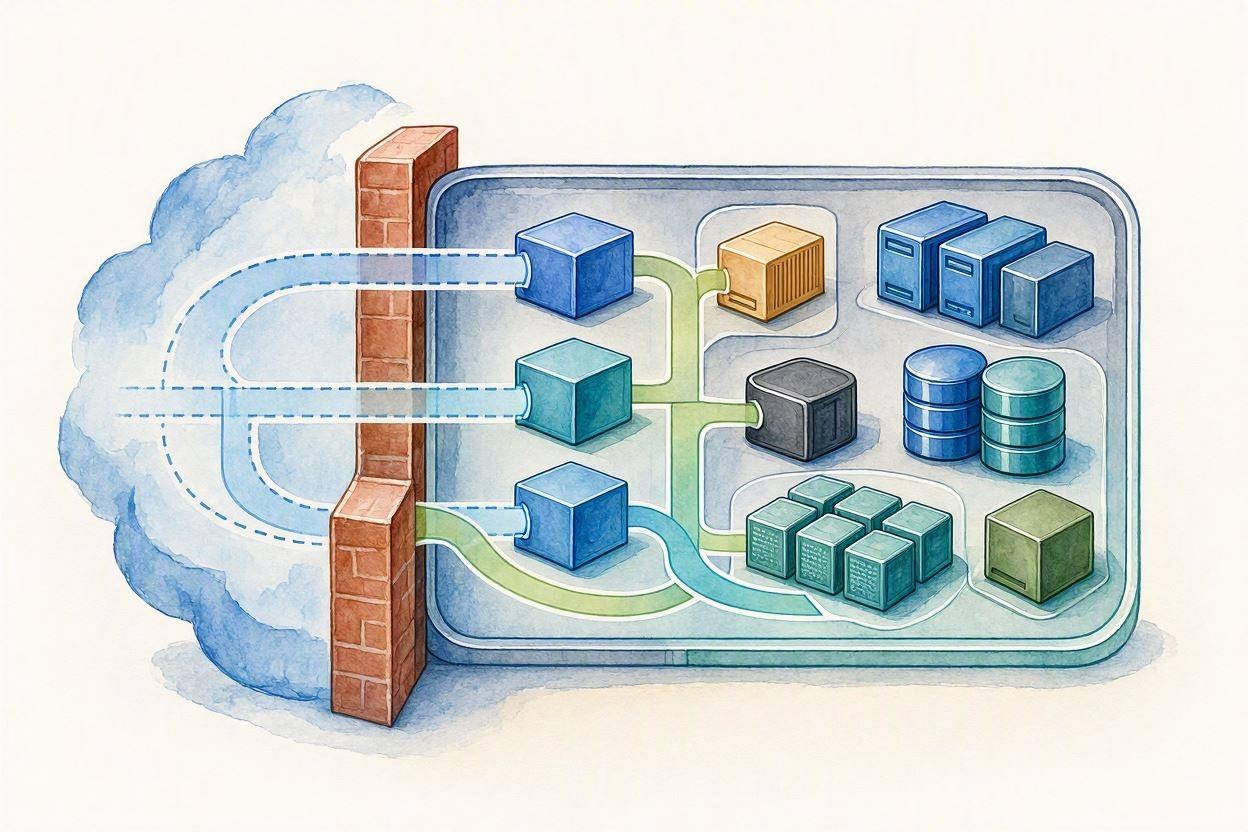
Relying solely on external scans leaves several critical blind spots:
- Lateral Movement Paths: Once an attacker gains a foothold inside your network - through a phishing email or a vulnerable third-party npm package - they can move laterally. External scans do not measure how easy it is to jump from a staging container to your production database.
- Misconfigured Internal Services: Services like Redis, Elasticsearch, or Memcached are frequently bound to local interfaces or private IPs during development. If firewall rules misfire or cloud security groups are misconfigured, these data stores can accidentally accept unauthenticated traffic.
- Staging and VPN Assets: Forgotten staging environments, old proof-of-concept servers, and internal VPN endpoints often lack the rigorous patching cadence of your main production app. They become backdoors into your corporate network.
- Exposed Database Ports: Internal ports like PostgreSQL (5432) or MySQL (3306) should never be reachable outside specific application subnets. Internal scanning validates whether your network segmentation actually holds up under pressure.
- Admin Tools on Private Nets: Internal admin panels, Kubernetes dashboards, and monitoring tools (like Grafana or Portainer) are often deployed behind private IPs with weak default credentials, assuming "nobody outside can see this."
Why SOC 2 and Customer Diligence Expect Internal Coverage
If you sell B2B SaaS, you already know the pain of enterprise vendor security reviews. Security questionnaires are getting longer, and procurement teams are getting smarter. It is no longer enough to check the box for "annual vulnerability scanning."
Compliance frameworks like SOC 2 (specifically Trust Services Criteria CC7.1) and ISO 27001 explicitly require organizations to identify vulnerabilities across both internal and external networks. Auditors want to see that you test your infrastructure defense-in-depth, not just your public web wrapper.
Did you know? Enterprise buyers increasingly request full vulnerability assessment reports during security reviews. Demonstrating regular internal and external scanning shows maturity and builds immediate trust, shortening your sales cycles.
Furthermore, cyber insurance carriers are tightening requirements. Many policies now demand regular vulnerability assessments and proof of internal network hygiene before paying out claims or renewing coverage. For more details on continuous compliance evidence and Vanta-ready reporting, see our guide on Vanta vulnerability scanning and vulnerability scanning for SOC 2.
A Practical Lightweight Approach for Indie SaaS
You do not need a multi-million-dollar security operations center (SOC) or a dedicated penetration testing firm on retainer to get started with internal vulnerability scanning. For indie founders and small teams, practicality is everything.
Here is how to build a lightweight, automated scanning routine without burning out your engineering capacity:
- Combine External and Internal Scanners: Use external application scanners to check your web perimeter, combined with an internal network scanner (like OpenVAS or automated cloud-native tools) deployed inside your VPC or local network via a secure agent or container.
- Add Authenticated Application Coverage: Pair network scans with authenticated DAST so you catch issues behind login that external perimeter checks miss. See our walkthrough of authenticated web application vulnerability scans.
- Automate Monthly and Event-Driven Scans: Do not rely on manual annual checks. Set up recurring monthly scans for both internal subnets and external endpoints. Trigger ad-hoc scans whenever you make major infrastructure changes, such as modifying VPC peering or deploying new microservices.
- Prioritize and Triangulate: Scanners spit out hundreds of low-severity findings. Focus first on high-risk vulnerabilities, unauthenticated remote code execution flaws, exposed databases, and outdated software packages with active exploits.

A Practical Internal and External Vulnerability Checklist
Use this actionable checklist to audit your current security posture:
Indie SaaS Vulnerability Checklist
- [ ] External perimeter scan executed against all public domains and API gateways.
- [ ] Internal network scan run inside your primary cloud VPC / subnet to check for exposed internal ports.
- [ ] Database instances verified to be completely isolated from public access and restricted by strict security groups.
- [ ] Developer workstations and staging environments audited for credential hygiene and outdated software.
- [ ] Container images scanned for known vulnerabilities (CVEs) before deployment to production.
- [ ] Dependency management tools (like Dependabot or similar) active and configured to auto-merge safe patch updates.
- [ ] Admin tools, monitoring dashboards, and internal debug endpoints protected behind VPNs or zero-trust identity-aware proxies.
Conclusion
External vulnerability scanning is an essential baseline, but treating it as your only security defense is like locking your front door while leaving your interior balcony doors wide open. For indie SaaS founders and lean MSPs, implementing internal network vulnerability scanning does not have to be a heavyweight chore.
By adopting a balanced approach that covers both external endpoints and internal service boundaries, you protect your infrastructure from lateral movement, satisfy rigorous B2B customer diligence, and keep your SaaS growing safely. Ready to secure your infrastructure from the inside out? Compare plans on our pricing page - internal network scanning is available on the Pro plan - or explore vulnerability scanning for MSPs.