
Vulnerability Prioritization for SaaS: Fix What Attackers Will Exploit First Written on . Posted in Informational.

Most SaaS teams do not fail at vulnerability scanning because they never scan. They fail because the first report lands as a wall of Critical and High findings, half of which are noise, and nobody has a clear rule for what to fix this week versus what can wait.
Vulnerability prioritization is the missing middle between running hosted vulnerability scans and actually reducing risk. Without it, continuous scanning just produces continuous overwhelm. With it, a lean founding team or MSP can turn network, application, and API findings into a short, defensible remediation queue.

Why raw severity scores are not enough
CVSS and scanner severity labels are a useful starting point, not a finish line. A Critical finding on an internal staging box that requires VPN access is not the same problem as a High finding on your public login API that sits on CISA's Known Exploited Vulnerabilities list.
SaaS founders and MSPs get stuck when they treat the PDF severity column as the priority list. That approach burns sprint capacity on theoretical issues while internet-facing auth, injection, and misconfiguration problems sit open.
Practical prioritization stacks a few extra signals on top of severity:
- Internet exposure - is the asset reachable without a VPN or private network?
- Asset criticality - production customer data path versus throwaway staging
- Exploitability - known exploit, weaponized CVE, or only theoretical
- Authentication context - unauthenticated reach versus deep behind login
- Blast radius - one tenant versus platform-wide impact
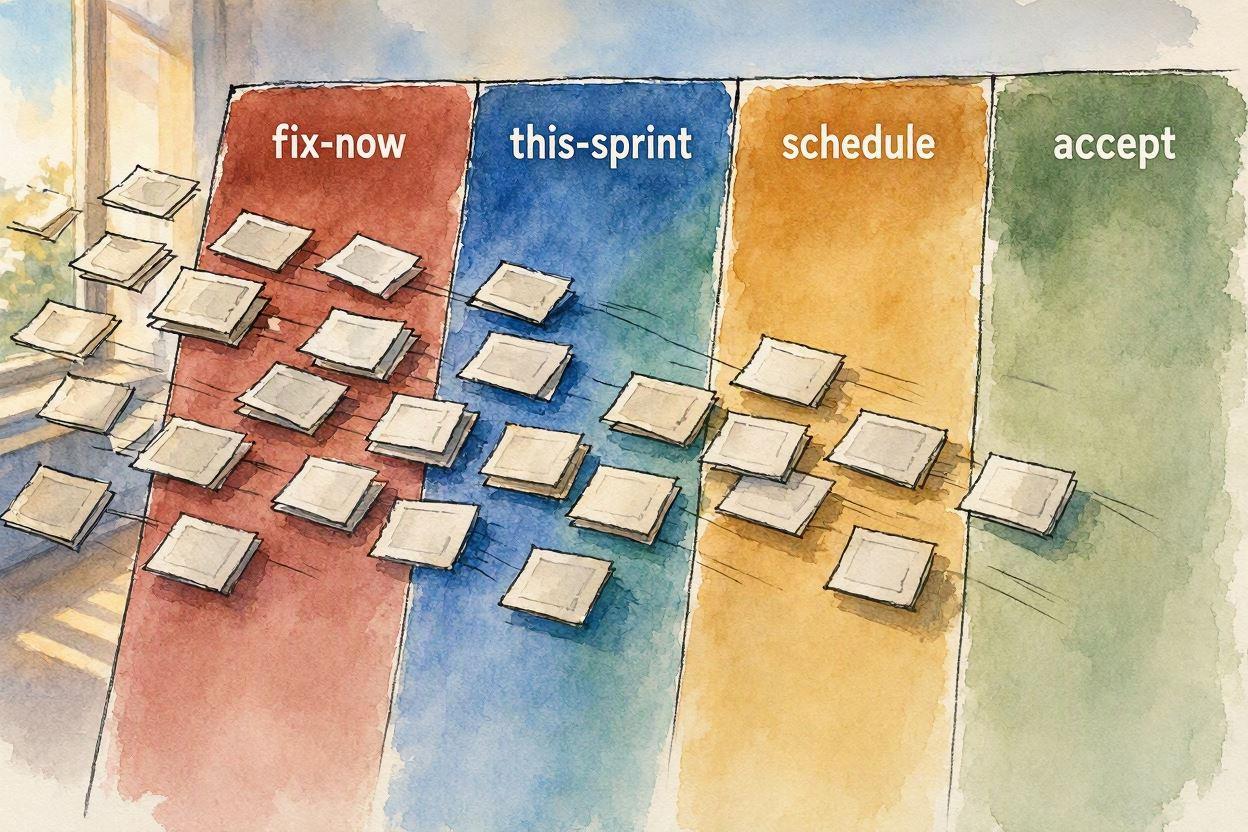
Build a triage ladder your team will actually use
You do not need a GRC platform to prioritize well. You need a short ladder that engineering and MSP client teams can apply in under ten minutes per finding batch.
- P0 - Fix now: Public-facing, exploitable, or on an active exploit list. Think exposed admin panels, RCE, auth bypass, or confirmed SQLi/XSS on customer paths.
- P1 - Fix this sprint: High severity on production assets, or medium severity with clear exploit paths on internet-facing services and APIs.
- P2 - Schedule: Real issues on lower-value assets, outdated libraries behind auth, or findings that need a change window.
- P3 - Accept or false positive: Documented accepted risk, misdetected versions, or scanner noise you have verified is not exploitable in your setup.
Panoptic Scans supports this workflow in the vulnerability management view: filter by severity and scanner, open a finding, then move it to Accepted Risk or False Positive when that is the honest outcome. The goal is a living queue, not a graveyard of ignored Criticals.
Separate noise from signal before you assign work
Scanner noise is real. Version fingerprint mismatches, informational SSL findings, and duplicate detections across OpenVAS, Nuclei, Nmap, and ZAP can make a 40-finding report feel like 200.
A few hygiene rules keep the queue honest:
- Keep production and staging as separate targets so staging noise never pollutes production remediation or audit evidence.
- Deduplicate the same CVE or plugin across engines before you create tickets.
- Mark verified false positives so they do not reappear as busywork after every scheduled scan.
- Re-scan after fixes - auto-resolve when the issue disappears, and treat reactivation as a signal that the fix did not stick.
If you only run unauthenticated web checks, you will also under-prioritize what matters inside the product. Pair perimeter and network coverage with authenticated web application vulnerability scans so post-login XSS, IDOR-adjacent paths, and settings-page flaws enter the same ladder.
Prioritize across network, application, and API surfaces
SaaS attack surface is rarely one scanner category. External network findings (open ports, outdated services), web app findings, and public API issues compete for the same two engineers.
A useful rule of thumb for lean teams:
- Public API auth and object-level access issues usually outrank most medium network CVEs - see our guide on API vulnerability scanning for indie SaaS.
- Internet-facing RCE and known-exploited CVEs outrank almost everything else. Cross-check urgent CVEs against the CISA Known Exploited Vulnerabilities catalog.
- Internal-only findings still matter for lateral movement, but they usually land behind public P0/P1 work unless they sit on a path to customer data. Pair perimeter work with internal network vulnerability scanning so those issues are visible, not forgotten.
Make prioritization visible for SOC 2 and customer diligence
Auditors and enterprise prospects care less about a perfect zero-finding report and more about evidence that you find issues, rank them, fix the important ones, and re-check. That story maps cleanly to SOC 2 CC7-style continuous monitoring expectations described in our SOC 2 vulnerability scanning requirements overview.
What good evidence looks like for a small team:
- Scheduled external and application scans with timestamps
- A triage log showing P0/P1 decisions, not only raw scanner exports
- Tickets or changelog entries tied to high-priority findings
- Follow-up scan results that confirm remediation
- Documented false positives and accepted risks with owners and dates
If you already use Vanta, connecting scan output through the Panoptic Scans Vanta integration reduces the copy-paste tax so prioritization time goes into decisions instead of PDF uploads.
A one-week prioritization cadence that scales
For most SaaS and MSP client accounts, this cadence works without a full-time AppSec hire:
- Run scheduled network and application scans (weekly is a strong default for internet-facing assets).
- Spend 30-45 minutes triaging new and reactivated findings into P0-P3.
- Assign every P0 the same day; cap P1 work to what the sprint can finish.
- Mark false positives and accepted risks with a short reason.
- Re-scan fixed targets and archive the before/after evidence.
MSPs can productize the same ladder as a client report: top open P0/P1 items, trend of open versus resolved, and a short note on accepted risk. That is more useful in a QBR than a 200-page Nessus dump.
Conclusion
Vulnerability scanning without prioritization creates anxiety. Prioritization without continuous scanning creates blind spots. SaaS founders and MSPs win when they combine recurring internal and external network and application coverage with a simple P0-P3 ladder, honest false-positive handling, and remediation re-checks.
Start with your latest scan results, sort by exposure and exploitability instead of severity alone, and clear the P0 queue before you debate medium findings. That habit compounds into better security, cleaner SOC 2 evidence, and customer diligence answers you can stand behind.